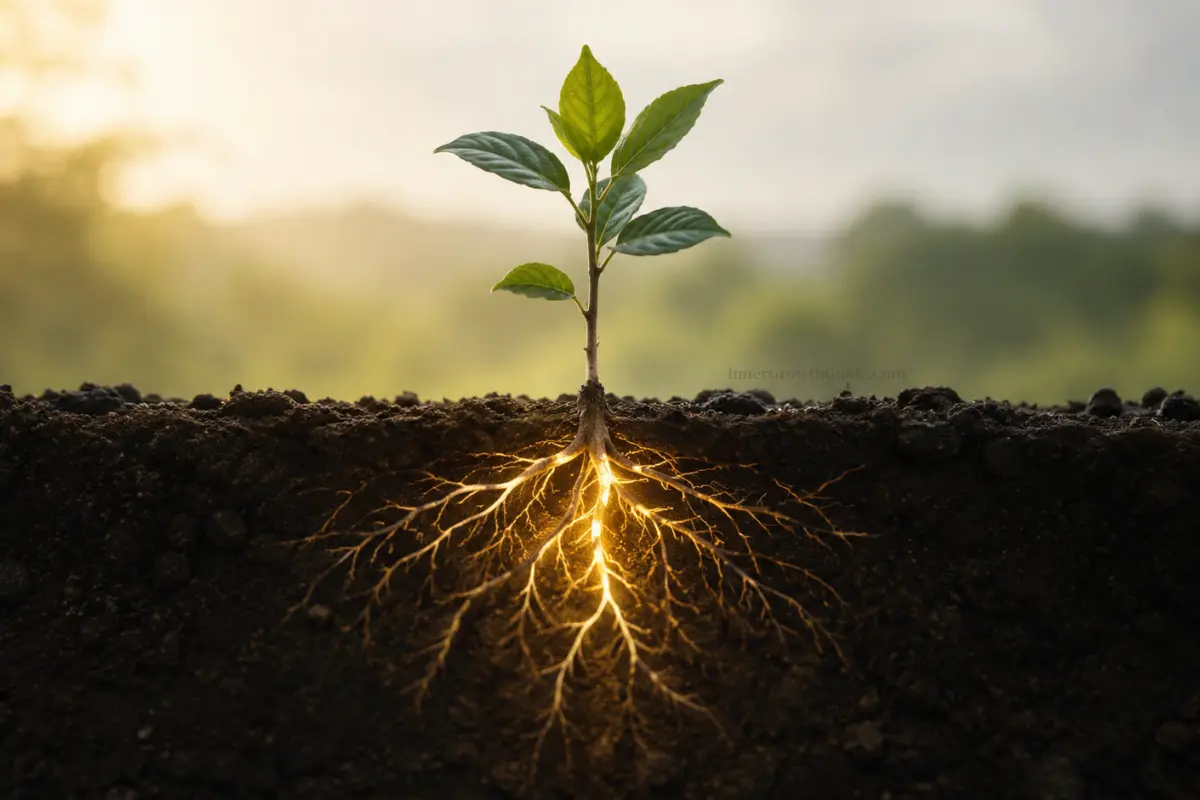
If you have ever reorganised your entire life, bought a new planner, joined a new gym, set a new 5 a.m. alarm, and still felt like the same restless person three weeks later, you have already bumped into the difference between outer change and inner growth. One rearranges the furniture. The other rewires the house. This guide is about the rewiring.
Inner growth is the quieter, sturdier kind of change. It rarely shows up on a to-do list and it almost never trends. But it is the thing that makes every other kind of self-improvement actually stick, which is why two people can read the same book, take the same course, or get the same advice and only one of them changes. Below, we will unpack what inner growth really means, why it feels so different from ordinary self-help, the five areas where it happens, how to recognise it when it is working, and how to begin without turning your whole personality into a stressful project.
What inner growth actually means
Inner growth is the ongoing process of developing your inner world: how you think, how you handle emotions, what you believe about yourself, and how you relate to the people and pressures around you. It is less about adding new things to your life and more about upgrading the operating system underneath it. When the operating system improves, everything that runs on top of it, your habits, relationships, work, and moods, tends to run better too.
A useful way to picture it: most personal development happens on two layers. The outer layer is behavior and circumstance: your habits, your job, your routines, your body. The inner layer is everything driving those things: your beliefs, your emotional patterns, your sense of self-worth, your values. Outer change without inner change is why people can hit an impressive goal and feel strangely empty at the top. The scenery changed; the person looking at it did not.
Psychologists sometimes describe this as the difference between first-order change (doing more or less of what you already do) and second-order change (shifting the underlying rules). Inner growth is squarely second-order. You are not just trying harder inside the same old story. You are changing the story you are trying inside of. That is why it can feel slower and less visible, and also why it lasts.
Inner growth vs. personal development: what is the difference?
People use these terms interchangeably, and that is mostly fine, but there is a distinction worth keeping. Personal development is the broad umbrella: skills, productivity, career, fitness, finances, and mindset all live under it. Inner growth is the mindset-and-emotion core of that umbrella. It is the part concerned with who you are becoming, not just what you are accomplishing.
The two feed each other. Learning to manage anxiety (inner) makes it easier to give the presentation (outer). Finishing a hard project (outer) can quietly teach you that you are more capable than you assumed (inner). Growth is healthiest when both layers move together. But when they compete, the inner layer is usually the bottleneck. You can install a perfect morning routine and still self-sabotage if, underneath, you do not believe you deserve for things to go well. Fix the belief and the routine suddenly gets easier to keep.
Why inner growth feels harder than it looks
Your brain is not neutral about change. It evolved to conserve energy and avoid risk, which means it treats your current patterns, even the ones making you miserable, as safe by default. This is why insight alone rarely fixes anything. You can know exactly why you procrastinate and still do it, because knowing lives in one part of the brain and habit lives in another. Understanding is the map; growth is the walking.
There is also the negativity bias to contend with. Humans are wired to notice and remember threats and failures far more vividly than wins, a tilt that once kept our ancestors alive. Left unchecked, that bias becomes a harsh inner narrator who keeps a detailed record of your worst moments and quietly loses the receipts on your best ones. A surprising amount of inner growth is simply learning to notice that narrator, question it, and stop treating every one of its bulletins as breaking news.
None of this means change is impossible. It means change is slow, and slow is not the same as failing. Expecting inner growth to feel like a training montage is one of the fastest ways to quit right before it starts working. Real growth looks less like a highlight reel and more like a slightly better response to the same old trigger, repeated until it becomes who you are.
The five areas where inner growth actually happens
“Work on yourself” is famously vague. In practice, inner growth tends to cluster into five concrete areas. You do not need to master all of them at once. Read through and notice which one is currently costing you the most peace; that is your starting point.
1. Self-awareness
Everything starts here. Self-awareness is the ability to notice what you are thinking and feeling in close to real time, instead of only understanding it in hindsight on the drive home. Without it, you are steering with a fogged windshield, reacting to weather you cannot see. With it, you can catch a spiral before it becomes a whole day, and name an emotion before it hijacks a conversation. Almost every other skill on this list depends on this one.
2. Emotional regulation
This is the skill of feeling something intensely without being run by it. Not suppressing emotions, which just puts them on layaway at a higher interest rate, but learning to sit with discomfort long enough to choose your response instead of firing off your reflex. It is arguably the highest-leverage inner skill there is, because the gap between feeling and reacting is where nearly all of adult life is won or lost.
3. Beliefs and mindset
The quiet assumptions you hold about yourself, things like “I am not a finisher” or “I am bad with people,” shape your behavior more than any goal you set. They act like invisible instructions. Shifting them is slow but transformative, and it is a big part of why a growth mindset matters so much: the belief that you can develop, rather than being fixed at your current level, changes how you respond to every setback.
4. Boundaries and relationships
How you protect your time, energy, and values, and how you show up for the people you love, is inner work with an outer footprint. Learning to set boundaries and say no without spiraling into guilt is one of the clearest signs that inner growth is taking hold, because it requires you to believe your needs count too.
5. Meaning and values
Eventually, growth stops being about fixing what is wrong and starts being about pointing your life at what actually matters to you. This is the shift from self-improvement as damage control to self-improvement as direction, and it is the foundation of intentional living. When you are clear on your values, a hundred small daily decisions get easier, because you finally know what you are deciding for.
How to know inner growth is actually working
Because inner growth is invisible, it is easy to feel like nothing is happening even when a lot is. Here are the quiet signals that you are genuinely changing, none of which look dramatic from the outside:
- The gap between feeling something and reacting to it gets a little longer. You pause where you used to snap.
- Old triggers lose some of their charge. The comment that would have ruined your week now stings for an hour.
- You can say no without a three-day guilt hangover, and yes without secret resentment.
- You catch your own unhelpful stories mid-sentence, instead of believing them for a week.
- You are kinder to yourself after a mistake, and you recover faster because of it.
- You compare yourself to who you were last year more than to whoever is on your screen.
Notice that every one of these is about a slightly better internal response, not a shinier external result. That is the whole texture of inner growth. If you are looking for it in your circumstances, you will miss it. Look for it in your reactions.
How to start (without overhauling your whole life)
The most common mistake is treating inner growth like a New Year’s resolution: dramatic, total, and abandoned by February. The better approach is almost boringly small, because small is what your change-averse brain will actually allow.
- Pick one area. Choose the single area above that is draining you most right now. One. Trying to fix everything at once is how people fix nothing, because attention is finite and scatter kills momentum.
- Get curious before you get critical. For one week, just observe your patterns without judging them. Notice when the harsh narrator shows up and what sets it off. Awareness has to come before change, because you cannot adjust what you cannot see.
- Make one small, repeatable move. A two-minute journal, one honest conversation, one “no” you would normally twist into a “yes.” Tiny actions repeated will always beat heroic actions abandoned.
- Expect the dip. There is often a stretch where growth feels worse before it feels better, because you are finally noticing things you used to numb or ignore. That is not regression. That is the fog clearing, and it is uncomfortable precisely because it is working.
| Try this: the two-minute evening check-in For one week, before bed, answer three questions in a notebook or your phone: What did I feel most strongly today? What triggered it? How did I respond, and would I choose that response again? You are not trying to fix anything yet. You are just building the self-awareness that every other kind of inner growth is built on. Most people are surprised how quickly patterns appear once they start writing them down. |
If you want a structured path from here, our guide on how to work on yourself turns these ideas into a step-by-step practice, and the Growth Library collects the rest of our guides by theme so you can go deeper on whichever area you chose. And if the patterns you notice feel rooted in old wounds, working with a therapist is a powerful accelerator rather than a failure, and it tends to speed up everything else.
Common myths about inner growth
A few beliefs quietly sabotage people before they begin. Clearing them out makes the whole process lighter.
- “If I were really growing, I would feel happy all the time.” No. Growth often means feeling your feelings more honestly, not less. Peace comes from handling emotions well, not from never having hard ones.
- “I should have figured this out by now.” There is no age by which a person is finished. The most grounded people you know are still working on themselves; they are just quieter about it.
- “I need to fix everything that is wrong with me.” You are not a broken object. Growth done well is less about repair and more about becoming more fully yourself, with fewer things in the way.
- “Real change should be fast.” The change that arrives fast usually leaves fast. Durable growth compounds quietly, like interest, and reveals itself in seasons rather than days.
A quick reframe to leave you with
Inner growth is not a destination you arrive at, cross off, and photograph. It is more like fitness for your inner life, something you maintain rather than something you complete. The goal was never to become a finished, flawless person. The goal is to become someone who can meet their own life, its ordinary Tuesdays and its genuine hardships, with a little more steadiness, honesty, and kindness than they had last year.
That is the whole project. It is not glamorous, it does not photograph well, and it will quietly change everything. The fact that you are reading this at all means you have already started.